The IMO Begins
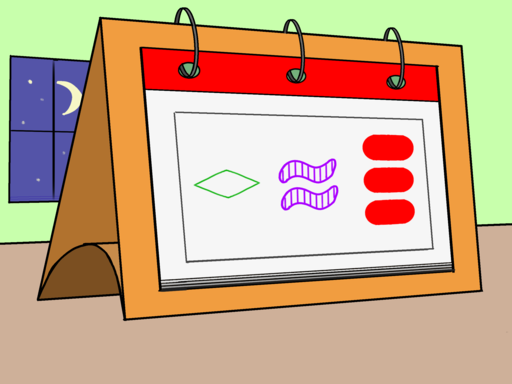
Finally, you figure out what the cards mean. The illustrations actually correspond to vectors in the space \[ v \in \mathbb{F}_3 \oplus \mathbb{F}_3 \oplus \mathbb{F}_3 \oplus \mathbb{F}_3 \cong \mathbb{F}_{81} \]
and you need to GET SUM NULL among triples of cards:
that is look for triples $(v_1,v_2,v_3)$ satisfying
\[ \sum_{i=1}^3 v_i = \mathbf{0}. \]
The MOSPers watch on in delight as you sweep away the sets, clearing out the starting day of the IMO in each calendar. Before you know it, the calendars are wide open again, and the nearby MOSPers resume filling them with various events, written again in whatever strange language is being used.
"How are you so fast?", one of them asks you, after watching you clear several Set's.
The correct answer here should be wait til they see Serena-san play. But you decide to respond instead by saying, "uh yeah, practice". Total cop-out, but hey, you're not getting paid for this job.
At least I'm useful for something, you think, as you walk on to the next building.
Solution
Finding Sets
Each of the ten calendars provided states a month and shows a layout of several Set cards. As directed by the flavortext, solvers should try to find L-shaped Set's among the calendar.
This is complicated by one additional factor: there is a Shift button which changes the day of the week the month starts on. This provides a way to potentially create additional Sets, since the calendar does not "wrap around".
In each calendar, there is a unique way to find eight sets, but there is not necessarily a unique way to shift it such that all the sets are valid.
Intersections
On the other hand, one can find a unique completely filled row and uniquely filled column, and these intersect to give a particular date. This gives the set of following set of possible dates.
| Calendar | Possible dates | |
|---|---|---|
| Board 1 | July 12 (Thu) | July 19 (Thu) |
| Board 2 | July 8 (Fri) | |
| Board 3 | Sept 19 (Sat) | Sept 26 (Thu) |
| Board 4 | July 11 (Thu) | July 18 (Sat) |
| Board 5 | July 14 (Wed) | |
| Board 6 | July 18 (Thu) | |
| Board 7 | July 3 (Thu) | |
| Board 8 | July 14 (Wed) | |
| Board 9 | July 4 (Wed) | July 4 (Fri) |
| Board 10 | July 4 (Wed) | July 4 (Fri) |
Matching up
To proceed further, it's necessary to think about the flavor text: you are looking for the start dates of the IMO starting from 2000 onwards. This explains why all the months are July except for one (September 2020, due to the COVID pandemic). For each board, exactly one of the dates corresponds to an IMO, and that date corresponds to exactly one IMO. One may then extract by taking A=1 ... Z=26.
| Calendar | IMO date | Year | Letter |
|---|---|---|---|
| Board 1 | July 19 (Thu) | 2007 | G |
| Board 2 | July 8 (Fri) | 2005 | E |
| Board 3 | Sept 19 (Sat) | 2020 | T |
| Board 4 | July 11 (Thu) | 2019 | S |
| Board 5 | July 14 (Wed) | 2021 | U |
| Board 6 | July 18 (Thu) | 2013 | M |
| Board 7 | July 3 (Thu) | 2014 | N |
| Board 8 | July 14 (Wed) | 2021 | U |
| Board 9 | July 4 (Wed) | 2012 | L |
| Board 10 | July 4 (Wed) | 2012 | L |
This gives the answer GET SUM NULL.